

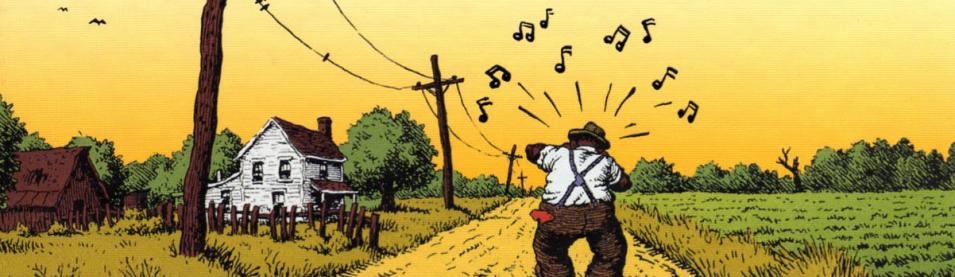
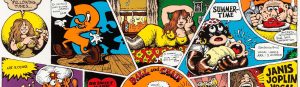
Born in 1943 in Philadelphia, Robert Crumb in a stifling family environment. From the age of two, Crumb in drawing. At age 18, he ran away from home and moved to New York. There, he worked as an illustrator of Postcards . In 1965, Harvey Kurtzman, creator of “Mad,” published a “Fritz the Cat” comic strip in “Help!,” along with two graphic features. (Reissued by Cornélius 1992). That same year, Crumb LSD, which completely changed his way of life and his approach to drawing. During a bad trip, he invented the characters who would become icons of “underground” culture: Mr. Natural, Angelfood McSpade, Mr. Snoïd, and others. He left for San Francisco and began drawing a “comic book,” without giving much thought to its distribution. This was *Zap*, which within a few weeks became a legend of hippie culture. His humorous style, the total freedom of his content—particularly in the depiction of his sexual fantasies—and his absurd humor influenced dozens of cartoonists. The “underground” comic was born. He hated hippie culture but nonetheless became a figure of the “counterculture.” When approached by mainstream publishers, he refused to work with them and continued to focus on low-budget comic projects. This uncompromising stance has remained a constant in his behavior to this day. In 1971, while living in a commune, he met Aline Kominsky, also a comic artist. A few months later, they left the group to live together. Crumb harder than ever. He encountered some difficulties with the emerging feminist movements, which were scandalized by the violence of his fantasies. In the late 1970s, Crumb drugs for good and evolved toward a more “realistic” style, incorporating the influence of the great English and French illustrators of the 18th and 19th centuries. He settled in the suburbs of San Francisco and launched the magazine “Weirdo,” which ran until 1987. There he published some of his best stories. He also adapted several literary texts: the English writer Boswell, a Grimm’s fairy tale, a passage from Sartre’s *Nausea*, and others. In 1988, an American publisher began reissuing his complete works, a project that is still ongoing today. In 1989, Crumb to move to the south of France with his wife and daughter. Two years later, the CNBDI dedicated an exhibition to him, titled “The World According to Crumb.” While continuing to work for the American market, Crumb masterfully Crumb a biography of Franz Kafka. He continues to produce comics in a flamboyant style with the same regularity and discretion, sometimes alone (the “Hup” series) and sometimes with his wife (“Dirty Laundry” and “Self Loathing”). He pays little heed to the recognition he eventually receives in his own country or the interest museums show in his work; he simply keeps drawing, time and time again.
In this section, you’ll find his limited-edition silkscreen prints and rare comic books…